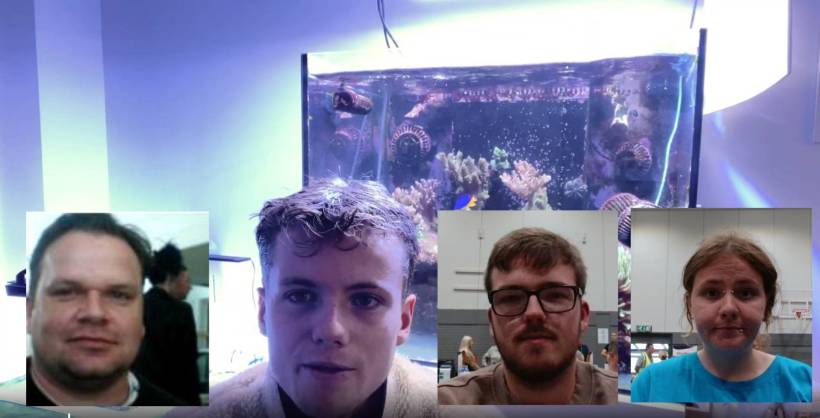
Above from left: Christian Thompson, Ellis Barton, Austin Kitching and Jess Norris, who will be presenting their research.
Ellis Barton: Evaluating the effects of dissolved organic carbon enrichment on scleractinian coral physiology.
Austin Kitching: Evaluating the effectiveness of bioremediation techniques in regulating the nutrient levels in the Main Lake, Williamson Park, Lancaster.
Jess Norris: The distribution of elasmobranch egg cases at five beaches on the Fylde Coast during the height of the spawning season.
Christian Thompson: Ecology and Habitat Use of the Velvet Crab (Necora puber): A Survey Across Intertidal Coastal Sites of the Fylde Coast.
Date: Wednesday 10th June 2026 Time: 19:30 to 21:00 Location: Lancaster Maritime Museum £4 donation to Lancashire MCS requested Everybody Welcome
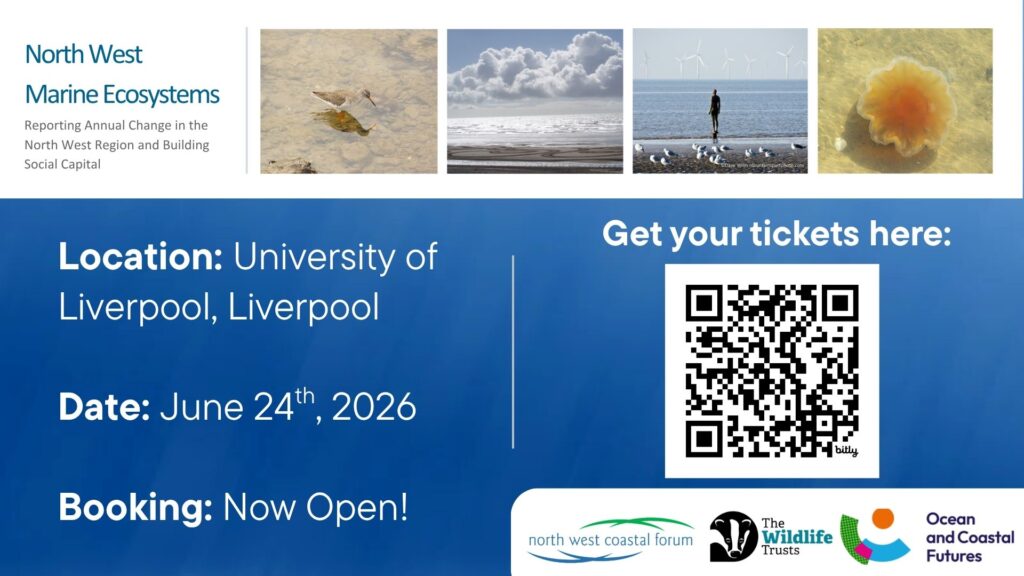
The North West Marine Ecosystems (NWME) Conference 2026 will be held at the University of Liverpool on 24th June. (Registration closes 17th June 2026). Use the QR code above to register, or follow the link below:
Extinctions, Isotopes and Us. A journey through time to the present.
After coming across references to the ‘Anthropocene’ in several sources Lewis decided that he needed to know more about it. Who coined the term? Why did they think it was needed? When did it start? This talk is an attempt to start to answer those questions and some of the many more that follow on from them.
Date: Wednesday 13th May 2026 Time: 19:30 to 21:00 Location: Lancaster Maritime Museum £4 donation to Lancashire MCS requested Everybody Welcome
Human muscle powered galleys were the pinnacle of sea power for most of human history. They were able to cross the Mediterranean in a matter of days, bringing news and transporting soldiers and precious cargoes. They had the decisive advantage over sailing ships in combat, as they could manoeuvre independently of the wind’s direction. This advantage was lost with the introduction of ship mounted artillery, the increased importance of Atlantic trade, and the development of the galleon…
Please note: This talk will be preceded by a short AGM for the group.
Date: Wednesday 8th April 2026 Time: 19:30 to 21:00 Location: Lancaster Maritime Museum £4 donation to Lancashire MCS requested Everybody Welcome
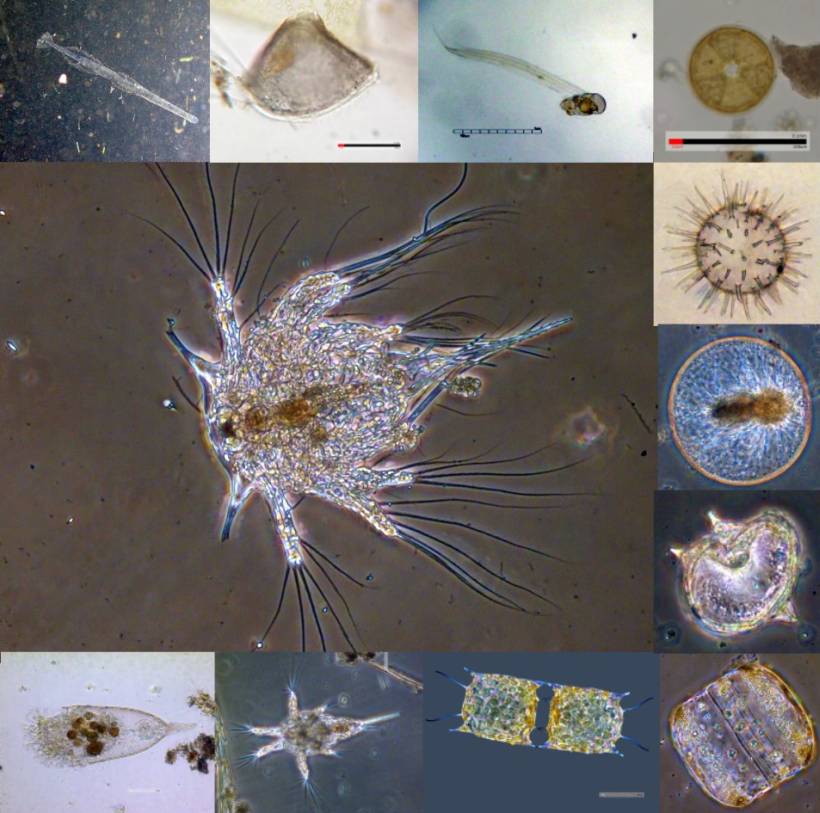
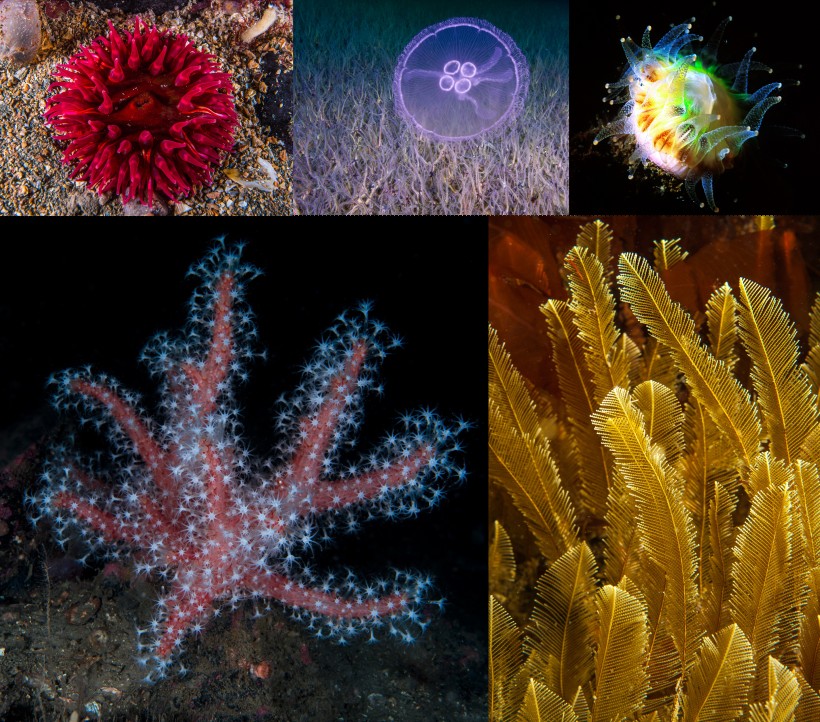
Above: Some plankton of the Irish sea – see how many you can identify! (Note the photos are not to the same scale). Photos BK from Knott End.
Most of the Irish sea is vertically mixed by waves and currents throughout the year, and has relatively little contact with the Atlantic. In addition, the waters in the Eastern Irish Sea, that lap our NW coastline, have been subject to massive human inputs, from industry, agriculture and major population centres. These factors have resulted in the development of a distinctly local flavour to the plankton population. This talk will attempt to show how plankton populations vary across the area in response to local conditions, using literature sources, and illustrated by our work at Knott End in the Wyre Estuary.
Date: Wednesday 11th March 2026 Time: 19:30 to 21:00 Location: Lancaster Maritime Museum £4 donation to Lancashire MCS requested Everybody Welcome
Our Christmas beach clean (like a beach clean, but usually with worse weather;-) will be on the 6th December at 14:00. Meet as usual at the Half Moon Bay Cafe car park.
This is followed by our Christmas quiz at the Maritime Museum on Wednesday 10th December.
Our annual brain-teaser returns to run a census on the old grey cells before the festive season takes its toll…
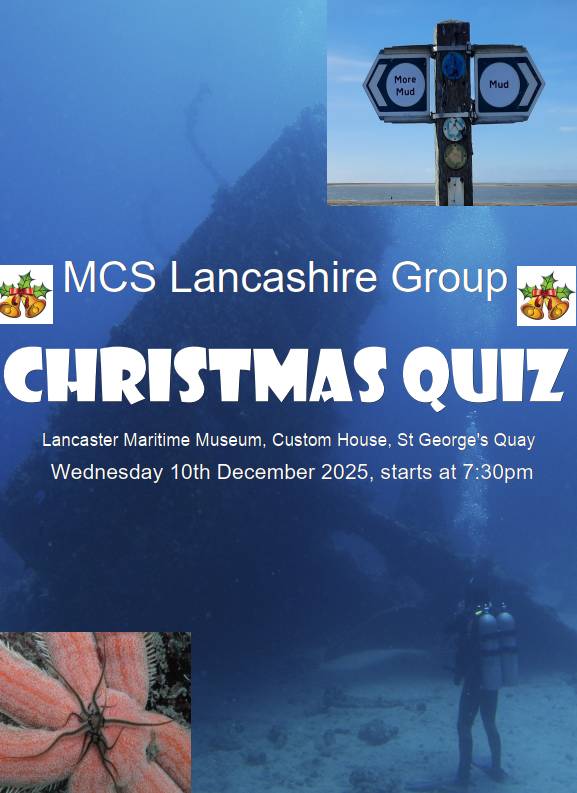
MCS Christmas Quiz at Lancaster Maritime Museum on Wednesday 10th December at 19:30 £4 donation to Lancashire MCS requested Everybody Welcome!
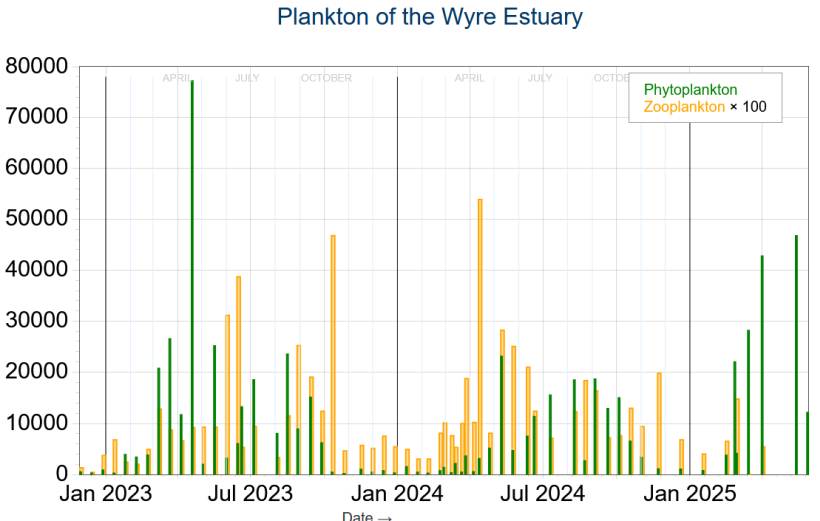
Above: Graph showing the variability in plankton numbers in the Wyre Estuary.
We have been monitoring the Plankton in the Wyre Estuary every fortnight since 2022, allowing us to pick out correlations between meteorological effects and plankton densities. The dramatic changes in weather patterns reported by our local weather station in Bradford suggest that there may be a corresponding discontinuity in plankton populations around the year 2000.
I regret that my laptop is not able to manage Zoom as well as my presentation, so there will not be an online option for this talk.
Meeting at Lancaster Maritime Museum on Wednesday 12th November at 19:30 £4 donation to Lancashire MCS requested Everybody Welcome
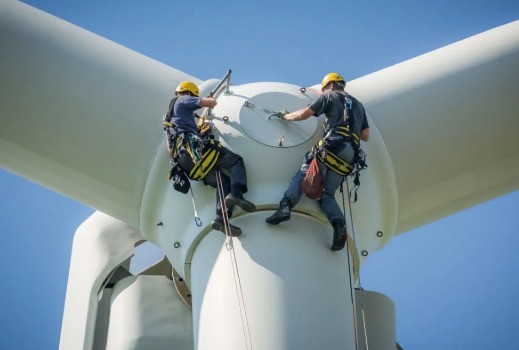
Above: Building a wind turbine – Morecambe OWF Project/Flotation Energy.
The UK has been a pioneer in offshore windfarm development over the past 20 years thanks to our shallow seas. There is now a wealth of data on their impacts to the marine environment and still many questions to be answered. Richard will be talking about the impacts of windfarms on marine ecological receptor groups and what measures windfarm developers take to minimise the impacts of their construction and operation.
Our speaker is unable ot make the advertised date due to ill health. I am sure we all wish him a very speedy recovery, and I hope to be able to re-schedule this talk later in our current programme.
POSTPONED Wednesday 12th November at 19:30 @ Lancaster Maritime Museum £4 donation to Lancashire MCS requested Everybody Welcome!
Hopefully the sun will have returned for our annual summer beach clean at Half Moon Bay, organised by Kathy MacAdam. Meet either at the Cafe car park just before 19:00, or on the beach if you arrive a little later. Please bring suitable clothing for the weather, we do have a number of litter-pickers, but you should bring tough gardening or similar gloves if you prefer to collect litter by hand. Children are welcome, but please bring a responsible adult!