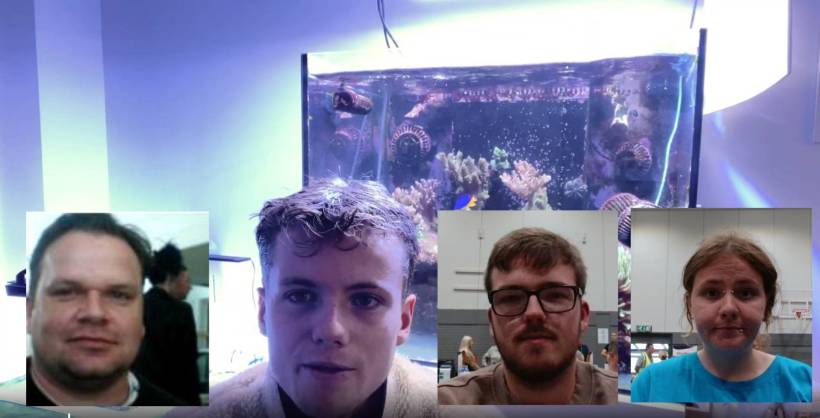
Above from left: Christian Thompson, Ellis Barton, Austin Kitching and Jess Norris, who will be presenting their research.
Ellis Barton: Evaluating the effects of dissolved organic carbon enrichment on scleractinian coral physiology.
Austin Kitching: Evaluating the effectiveness of bioremediation techniques in regulating the nutrient levels in the Main Lake, Williamson Park, Lancaster.
Jess Norris: The distribution of elasmobranch egg cases at five beaches on the Fylde Coast during the height of the spawning season.
Christian Thompson: Ecology and Habitat Use of the Velvet Crab (Necora puber): A Survey Across Intertidal Coastal Sites of the Fylde Coast.
Date: Wednesday 10th June 2026 Time: 19:30 to 21:00 Location: Lancaster Maritime Museum £4 donation to Lancashire MCS requested Everybody Welcome
Extinctions, Isotopes and Us. A journey through time to the present.
After coming across references to the ‘Anthropocene’ in several sources Lewis decided that he needed to know more about it. Who coined the term? Why did they think it was needed? When did it start? This talk is an attempt to start to answer those questions and some of the many more that follow on from them.
Date: Wednesday 13th May 2026 Time: 19:30 to 21:00 Location: Lancaster Maritime Museum £4 donation to Lancashire MCS requested Everybody Welcome
Human muscle powered galleys were the pinnacle of sea power for most of human history. They were able to cross the Mediterranean in a matter of days, bringing news and transporting soldiers and precious cargoes. They had the decisive advantage over sailing ships in combat, as they could manoeuvre independently of the wind’s direction. This advantage was lost with the introduction of ship mounted artillery, the increased importance of Atlantic trade, and the development of the galleon…
Please note: This talk will be preceded by a short AGM for the group.
Date: Wednesday 8th April 2026 Time: 19:30 to 21:00 Location: Lancaster Maritime Museum £4 donation to Lancashire MCS requested Everybody Welcome
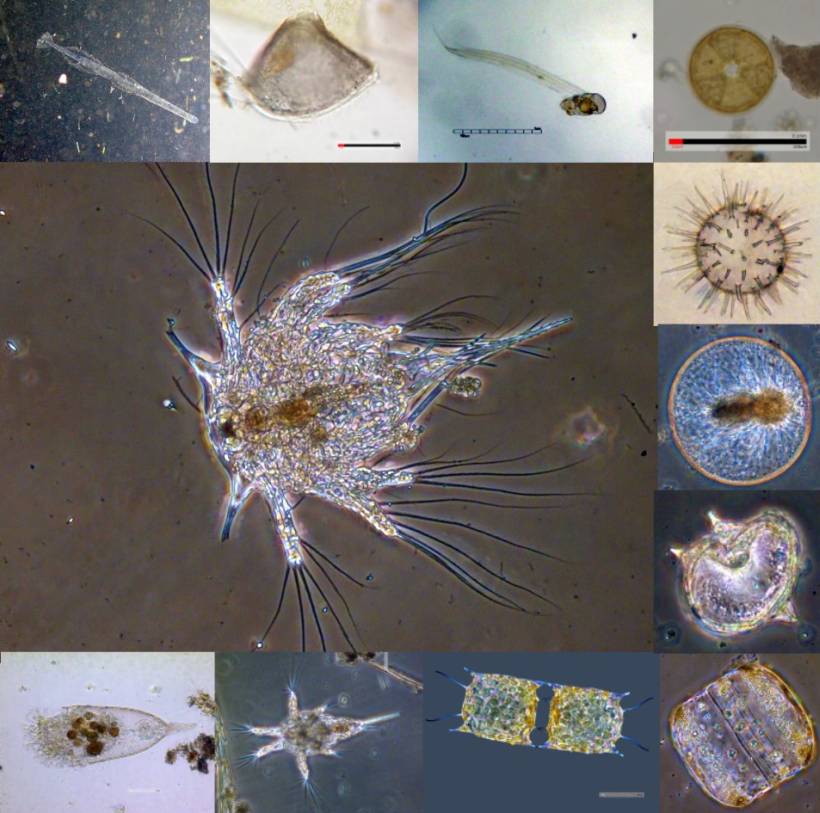
Above: Some plankton of the Irish sea – see how many you can identify! (Note the photos are not to the same scale). Photos BK from Knott End.
Most of the Irish sea is vertically mixed by waves and currents throughout the year, and has relatively little contact with the Atlantic. In addition, the waters in the Eastern Irish Sea, that lap our NW coastline, have been subject to massive human inputs, from industry, agriculture and major population centres. These factors have resulted in the development of a distinctly local flavour to the plankton population. This talk will attempt to show how plankton populations vary across the area in response to local conditions, using literature sources, and illustrated by our work at Knott End in the Wyre Estuary.
Date: Wednesday 11th March 2026 Time: 19:30 to 21:00 Location: Lancaster Maritime Museum £4 donation to Lancashire MCS requested Everybody Welcome
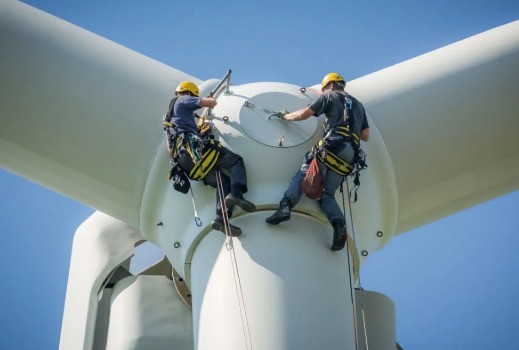
Above: Building a wind turbine – Morecambe OWF Project/Flotation Energy.
The UK has been a pioneer in offshore windfarm development over the past 20 years thanks to our shallow seas. There is now a wealth of data on their impacts to the marine environment and still many questions to be answered. Richard will be talking about the impacts of windfarms on marine ecological receptor groups and what measures windfarm developers take to minimise the impacts of their construction and operation.
Our speaker is unable ot make the advertised date due to ill health. I am sure we all wish him a very speedy recovery, and I hope to be able to re-schedule this talk later in our current programme.
POSTPONED Wednesday 12th November at 19:30 @ Lancaster Maritime Museum £4 donation to Lancashire MCS requested Everybody Welcome!
Our last talks for the 2024-25 season cover two topical subjects – the management and welfare of wild animals in captivity, and the migration of micro-plastics through the marine food chain, and potentially into humans. These challenging subjects have been taken on by students from Blackpool and Fylde College, so I hope you will be able to join us in supporting them at this early stage in their research careers!
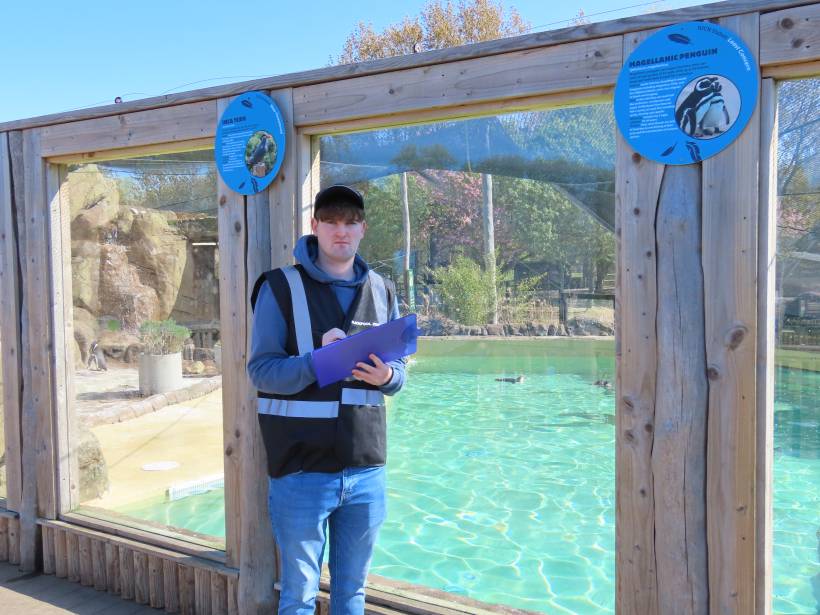
Above: Alex Carter recording penguin behaviour at Blackpool zoo.
Unveiling the invisible threat within the food chain by Heather Race
The aim of this research is to discover the extent of microplastic contamination in fish intended for human consumption, with a specific focus on mackerel. Also to determine if microplastic is present in the flesh and not just the gastrointestinal tract, while also examining trophic transfer from shrimp to mackerel and to tuna.
Analysis of the influence of changing zoological conditions upon Magellanic penguins, ‘Spheniscus magellanicus’ by Alex Carter
Ten years ago, a student at Blackpool and the Fylde College researched the behaviour of the Magellanic Penguin colony at Blackpool Zoo. Since then, several changes, including a £100K enclosure expansion and renovation in 2023, have been completed. Study of other avian species have suggested expansion has a positive influence and therefore assessment to ascertain an accurate assessment of behavioural changes could support zoo expansion and the continued efforts of zoos to provide the best environments and care for their animals despite some people’s concerns.
At Lancaster Maritime Museum, Custom House, St George’s Quay, Lancaster, LA1 1RB £4 donation requested to Lancashire MCS Everybody Welcome!
A talk by Nigel Neil (Lancaster and District Heritage Group and Neil Archaeological Services) on Wednesday 14th May at 19:30 at the Lancaster Maritime Museum.
Above: The remains of the Imperatriz, wrecked in 1866, photo by Nigel Neil.
Imperatriz was on its way from Mazagan (now called El Jadida) in Morocco, to Lancaster, carrying Indian corn when it was wrecked on Saturday June 2nd 1866. The accident occurred whilst Imperatriz was being towed up the River Lune by a steam tug, and ran aground on the riverbed a few hundred yards from New Quay. Press coverage tells part of the story, and salvageable items, and the hull itself, were auctioned at New Quay on 25th June 1866, raising £166.
The outline of the ship remains visible at low tide, when silt does not cover it. Members of the Lancaster and District Heritage Group (LDHG) have undertaken desk-top survey and some field recording, but more remains to be done. Mr Neil’s talk will also touch upon some other highlights of maritime archaeology around Lancaster.
Wednesday 9th April 19:30: by Mark Woombs and Barry Kaye PLUS group AGM by Kathy MacAdam.
Last year I showed a probable relationship between plankton blooms in the Wyre Estuary and the number of hours of sunlight, and I speculated that better weather in Spring this year might see a repeat of the Odontella bloom that characterised the early parts of 2022 and 2023, but was completely absent in 2024. We have certainly had good weather this Spring, so we will see how this has impacted our local phytoplankton in this talk!
Part of my research has been looking at local Met Office records, to quantify what weather we should expect at different times of the year, and how much this varies. This turned up some interesting results – if you thought that the best of the weather was now in the Spring, and our Summers are not as good as they were in your childhood, then, (depending on how old you are!) there might be some truth in this:
Above: Average hours of sunlight per month between 1908 and 2025, compared with 2000-2025 from data published by the Met Office for Bradford. The data show that there is more sun in Spring, but less in our traditional Summer. The graphs overlay a micrograph of a cell of the phytoplankton Odontella regia, which may be impacted by the changes.
Above: Photomicrograph of Porcellidium sp. by Mark Woombs
The meeting will start with a brief AGM hosted by Kathy. This will be followed by two short talks rounding up plankton studies in the Wyre Estuary over the last 12 months. Mark will look at how to get their ‘best side’ when photographing zooplankton, while I will attempt to shed more light on the question of whether phytoplankton respond to the weather (and how to measure these changes).
At Lancaster Maritime Museum, Custom House, St George’s Quay, Lancaster, LA1 1RB £4 donation requested to Lancashire MCS Everybody Welcome!
Above: An Egyptian warship at the Battle of the Delta, 1175 BCE. Sketch based on the carved relief from the mortuary temple of Ramesses III at Medinet Habu, Egypt (BK 2025).
This talk will follow the development of warships from the earliest times – the first recorded naval battle in the late Bronze Age, through the developments in the classical period – the ‘trireme’ and all that! Finally we’ll look at how sailing warships gave way to the first ironclads after the Industrial Revolution.
At Lancaster Maritime Museum, Custom House, St George’s Quay, Lancaster, LA1 1RB