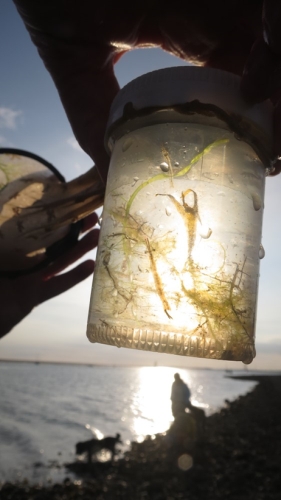
Our first Roa Island shore walk this year took place on Saturday 24th July. Understandably, given the late decision to hold this, turnout was lower than normal but 5 of us had an interesting time scouring the shore for life. Sadly the first find of any interest was 30-40m of discarded fishing line tangled in the wrack under the walkway to lifeboat station. This took about 20 minutes of patient work to disentangle it so that it could be taken away for disposal. Thankfully the rest of the beach was relatively clear of litter!
Pacific oysters (Crassostrea Gigas)
We saw quite a large number of Pacific oysters Crassostrea Gigas (sometimes known as Portuguese Oyster). These are a non-native commercial species; it’s possible that they have originated from oyster farms in the Menai Straits, although there is an oyster hatchery on Walney Island that puts some immature stock in the Bay to grow on before selling them on to other farms to mature and this may be the source too.
Dislodged sponge
It was noticeable that there were quite a few large pieces of dislodged sponge and sea squirts, probably from deeper water, at the low water line. It wasn’t clear how these had been dislodged, whether it was manmade disturbance – we didn’t see a dredger while we were there for instance – or a natural process, but it did bring some species to view that we may not have seen otherwise. For instance these Oaten Pipe hydroids (Tubularia indivisa) living on one of the detached sponges.
Mysid shrimp captured in a shallow water trawl. Photo Lewis Bambury.
Barry tried some plankton trawls in the shallows where large numbers of mysid shrimp and small (juvenile) fish were swimming against the incomming tide, hoping for it to bring them supper! Microscopic examination revealed a phytoplankton community dominated by pennate diatoms (Proboscia alatum and Rhizosolenia sp.), though we did see one centric diatom Odontella mobiliensis. The trawl also contained some lanceolate Naviculacea (Pleurosigma sp. – probably angulatum), and one example of Bacillaria paxillifera; these are typically benthic/surface dwelling diatoms, but very commony found in shallow water trawls. There were also a number of periwinkle (Littorina littorea) eggs and newly hatched ‘velligers’. Juvenile periwinkles (the ‘velligers’) are planktonic, and use cillia covered extensions of their ‘foot’ (called a ‘vellum’) to swim. This mode of propulsion is very effective in the smaller juveniles, allowing them to make respectable swimming speeds (Olympic qualifiers – for ther size!) as they actively hunt for food, which is usually smaller zooplankton.
Periwinkle egg containing two velliger embryos – very close to hatching! Micrograph by Barry Kaye.
Lockdown has meant that the best tides for this have passed us by this year, but this was the first of two dates that we picked as having the chances of interesting finds. The timing of Spring tides around Morecambe Bay means that the very lowest tides – when we have the best chance of finding some of the creatures that are normally hidden – happen around 6 or 7 am, of 6 or 7 pm, so daylight times are a factor in choosing dates too.
Our next walk is on the calendar for Wednesday 8th September at 19:00 (Low water 0.95m at 19:42, just before sunset).
Report by Lewis Bambury with additions on microscopy by Barry Kaye.
Our online ID course on Wednesday 20th January 2021 will look at some of the most common phytoplankton sampled from the Morecambe Bay area and the West Coast of Scotland. This is a basic introduction to sampling and identification.
The opportunities for communal beach surveys this year are a bit limited, but you can still enjoy a visit to the beach for a (socially distanced) walk or rock-pool hunt, and we have plenty of good beaches to visit around the Bay (so there is no need to crowd!) As we cannot be with you to help you identify what you have found this year; I include a few resources below that might help – so take a photo of what you find, so you can look it up later!
Online photographic guide
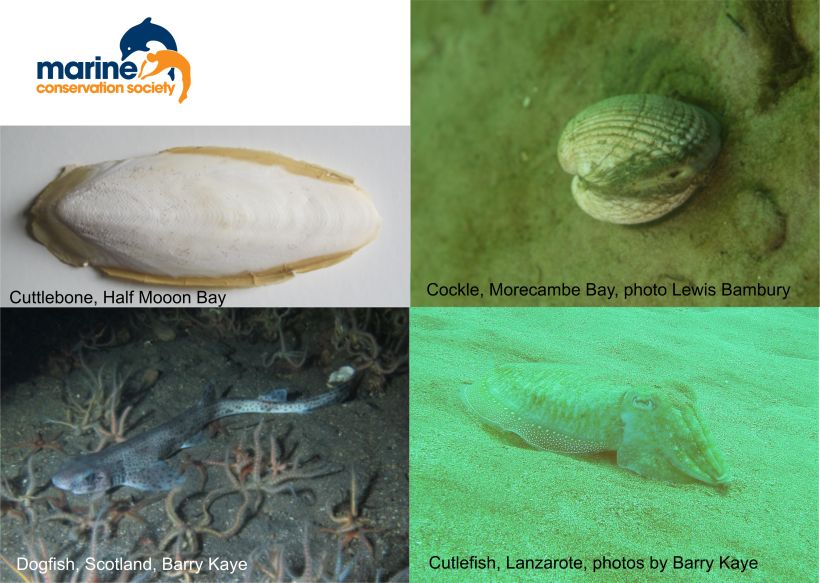
Walking the beaches around Morecambe bay you will find lots of shells – many from cockles – shown live underwater top right above. You can also find evidence of more interesting dwellers in the deeps though: The cuttlebone was one of a pair we found at Half Moon Bay in August 2015 – a live cuttlefish is shown bottom right. Occasionally you will find a dead dogfish on the beach – trapped in the rocks at Heysham point, perhaps, but at the right time of the year you will find lots of mermaid’s purses, which are their egg cases!
National MCS has a nice photographic guide to UK coastal wildlife, which you can access through the link below. The photographs are mostly taken underwater, in the plant or animal’s natural habitat, so you may need to look carefully at a specimen you find in the strand line.
The most common jellyfish in the Bay are the Lion’s mane (above left) which can give you a nasty sting (you can see masses of stinging tentacles hanging below the animal in the photo), and the Moon jelly (above right), which is harmless. Lion’s manes can grow to over one hundred meters in length – including their tentacles – making them one of the largest animals on the planet!
Jellyfish are voracious predators on plankton and smaller animals at sea. They live seasonal lives, most die over winter, with a new crop appearing in late spring, and multiplying rapidly to form vast swarms. Fish competed with jellyfish for food, but in some parts of the world, over-fishing has removed this competition, and Jellyfish swarms can become very large indeed.
Unlike fish, jellyfish are not powerful swimmers, and in late summer large numbers from these swarms can be washed up on beaches – where you will often find them beached from the strand line to the water line.
Take care approaching stranded jellyfish – they all rely on stinging cells to paralyse their prey so their tentacles can bring it to their mouths to feed. Jellyfish that live on plankton are safe to handle, but jellyfish that take larger prey items – like small fish – are heavily armed, they will cause painful stings. If you are not sure what you are looking at, don’t touch it, and be aware that fine tentacles may spread out for some distance around the main body or bell, and can stick to shoes, buckets, spades or clothing, and give you a nasty surprise after you have left the beach!
National MCS has a helpful guide to common UK Jellyfish online at the address below. Most of the Jellyfish around Morecambe Bay will be wither Moon Jellyfish (safe), or Lions Manes (look like burst tea bags – can give you a very nasty sting), but we occasionally get rarer individuals or swarms.
You can use the online guide above to identify what you have found, and report more unusual findings to the National MCS below
We will be happy to try an help you identify plants and animals you find on the beaches around the Bay – if you can take a photo and email it to us at: strandline_AT_lancashiremcs.org.uk (replace _AT_ with @). Please tell us where you found it, and whether or not you are happy for us use the photograph on this website.
A talk presented by Barry Kaye (Lancashire MCS) March 2020. References and further reading are presented below the main talk.
Marine Plants
Most marine plants are microscopic ‘phytoplankton’. Of those that are large enough to see, the most common are ‘seaweeds’. These plants are adapted to live in shallow marine and intertidal areas where there is plently of light. Seawater provides the nutrients seaweeds need to live, so they just need to cling on to their preferred location, so they are not swept somewhere less hospitable: Where there is insufficient light or nutrients for them to compete with other species, or where they may be eaten faster than they can grow.
To do this they use a ‘holdfast’, which may appear root-like, but which works more in the manner of a hand, gripping a rock, rather than a root, which penetrates the soil.
Higher Plants
‘Higher’ plants have largely solved the problems of living on land. There is lots of light above ground, but the entire plant is not bathed in nutrients – these must be extracted from ground water through roots, which are buried away from the sun. Light absorbtion requires specialised leaves or fronds, held some distance above the ground to get the most light. The division of labours requires a sophisitcated transport (‘vascular’) network to bring together the requirements for photosynthesis, and spread its benefits to all parts of the plant.
These plants are not, however, well adapted to life in the sea – underwater there is less light than they are used to. Further, marine sediments are typically anoxic, so any part of the plant penetrating them must be supplied with oxygen to survive. As a consequence the roots would depend entirely on the exposed leaves for all of life’s essentials.
While roots do not help sustain the plant in a marine ecosystem, they can anchor it in soft sediments. This is an ecosystem that seaweeds cannot easily colonise, as their holdfasts have very little to grip onto, so cannot hold their position in anything other than the slightest currents. Some seaweeds have developed ingenious methods for reducing the strain on their holdfasts, such as springy bodies that absorb wave currents, rather than transmitting these stresses to the holdfast, which might become dislodged (see the ‘rubberiest plant on the planet‘ elsewhere on this blog, which provides insight into the complex internal structures displayed by some seaweeds – though these structures are rarely associated simply with transport of nutrients).
As a consequence, areas of shallow seas with soft sediments – sands or muds – can be successfully colonised by higher plants, with little competition from the otherwise well established seaweeds. The plants that have succeeded in doing this are called ‘seagrasses’. There a number of superficially similar species around the world, their forms being dictated by the rigours of the environment they have colonised.
Sheltered community
While seagrasses have been shaped by their environment, they also have an important role in shaping the environment in which they live. Seagrass shelters the water beneath its canopy, providing a refuge for juvenile fish, and stabilising the sediment for burrowers.
The blades of seagrass also exert a drag on the waves that pass over them. It has been calculated that substantial seagrass meadows can reduce wave height by as much as 50% on its trip from the open sea to the shore. (This is a very substantial reduction in wave energy, which is proportional to the square of the wave height).
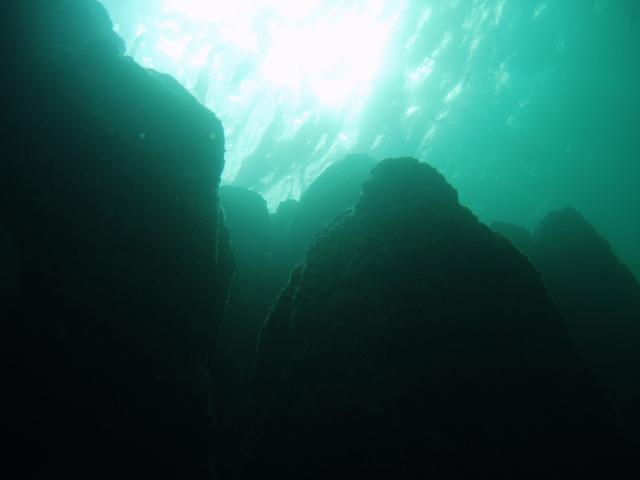
In short, seagrass is as valuable as it is unlikely, supporting fisheries, and protecting coastal communities (and proterty). In the UK we only have one truly marine species of seagrass – Zostera maritima, which is shown in the photograph above. You can see some of the species that make it their home – two spot gobies, with a larger fish lurking in the background. The diversity of community is made clear when you compare the photo above to that below – taken of an adjacent patch of bare sand:
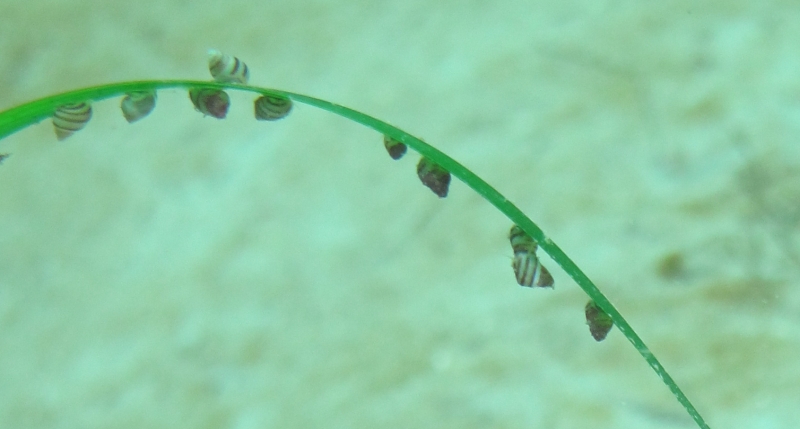
While seaweeds find it hard to establish on open sand, if there are no larger rocks to cling to, they have no problem colonising the seagrass itself. Often blades of seagrass are thickly tufted with fine filamentous algae – which are a serious problem, as they reduce the amount of light the seagrass gets. Fortunately, help is on hand from a range of small sea-snails, who are quite happy to eat the offending algae, providing a serendipitous cleaning service for the seagrass.
Above: Banded snails (Barleeia unifasciata) cleaning algae from a blade of seagrass.
Algae and snails are not the only organisms to attach themselves to seagrass blades, and for some the presence of seagrass is essential for their survival. The critter below is a marine oddity – a stalked jellyfish. It belongs to a broader group that includes anemones and jellyfish. Indeed, this staked jellyfish is one that has given up its free floating existance and become tied to the seagrass. As a group the stalked jellyfish are characterised by their ‘stay at home’ nature. Not only have they given up a life of constant voyage, but they do not travel even as juveniles.
Haliclystus octoradiatus photographed off the Isle of Gigha, October 2019. Haliclystus seems to be associated with more overgrown blades, and I wonder if it is eating the seagrass cleaning service?
Disappearing meadows
As a home to stay-at-home species like the stalked jellyfish, you would think that seagrass meadows must be pretty stable places – stable enough that you don’t need to look for a new home very often at least! Indeed, seagrass meadows off the island of Ibiza in the Mediterranean have been estimated to be thousands of years old…
Sadly, the last century has shown that many seagrass meadows are in fact very fragile. It is estimated that approximately 90% of the area of seagrass meadows around the UK have been lost in the last century. The largest losses occurred in the 1930’s, but there has been limited or no recovery since.
Disease
Blades of seagrass showing bleaching and black spots characteristic of infection with Labarinthula in a meadow that is otherwise unaffected.
Zostera maritima has been lost from all North Atlantic coastal regions. The principle cause of the loss has been put down to disease. The slime mould Labyrinthula zosterae, thought to be the culprit, colonises modern meadows, but generally without ill-effect. It seems that since the mass deaths of the 1930’s Zostera and Labarinthula have come to an uneasy truce. If the Zostera is stressed in any way, however, then Labarinthula gains the upper hand, and the plant will quickly die…
Stressed seagrass
Pollution: When we think about marine pollution, catastrophic oil spills grab the headlines, and so dominate our perceptions. Most Zostera beds are, however, relatively resistant to oil spills; paradoxically the oil-dispersant mixtures used to break the slick up and get it off our beaches, can be more damaging. Problems due to elevated nutrient levels from sewage and agricultural run-off, are insiduous, and very much harder to quantify and mitigate…
One result of elevated nutrient levels in seawater is the growth of algae – in the water column, and attached to the Zostera blades. Both of these reduce the light reaching the plants. Human activity can also effect the amount of light reaching the meadow, by suspending fine sediments in the water column through dredging, or bottom trawling.
A final insult to seagrass beds from human activity are the moorings of leisure craft. Typically these moorings have a length of chain running along the bottom that provides play to allow the boat to rise and fall with the tide. As the boat does so, and moves in response to wind and currents, however, the chain is dragged accross the sea bed, leaving cleared circles in the seagrass beds that can be seen from space…
Not all of seagrasses stress is from humans – prior to 1930, seagrass beds were the primary food source for Brent geeseBranta bernicla. When the seagrass died, so did the geese. In fact the species was nearly extinguished by the tragedy, and only escaped extinction by broadening its diet to take sealettuce (a seaweed). Modern brent geese have further diversified to forage on coastal grasslands , resulting in a resurgence for the species.
Unfortunately Brent geese still have a liking for seagrass; but the seagrass meadows have not recovered. As a consequence a large flock of geese can cause considerable damage to any meadows in their environ.
Plans for recovery
Globally, seagrass meadows still have massive economic significance. They are a nursery for many commercial and subsitance fisheries, and have an important role in coastal protection. Often, however, their loss is most keenly felt by the poorest; those whose means of subsistence has been lost, who cannot afford sea defences, or to move as the sea sweeps in…
It was heartening, therefore, to read of a UK innitiative to try and reverse this trend of loss. Reported in the Guardian on the 10th March 2020, Project Seagrass has a global outlook, but most interestingly for me, is looking at re-seeding areas of former seagrass beds at Dale Bay in Pembrokshire. I wish them luck in their enterprise (and you can donate to their efforts through the link in the references section below!)
References – further reading
The drawings and photographs illustrating this piece are my own – I am not able to display some of the slides I used in the talk here for copyright reasons.
Estimates of the reduction in wave energy due to seagrass beds can be found in: Effect of a seagrass (Posidonia oceanica) meadow on wave propagation by E. Infantes, A. Orfila, G. Simarro, J. Terrados, M. Luhar and H. Nepf. in Mar Ecol Prog Ser 456: 63– 72, 2012. https://doi.org/10.3354/meps09754
A study on the diversity and stability of seagrass meadows can be found in Long-term persistence of structured habitats: seagrass meadows as enduring hotspots of biodiversity and faunal stability by A. Challen Hyman, Thomas K. Frazer, Charles A. Jacoby, Jessica R. Frost and Michał Kowalewski. Proc Roy Soc B Published:02 October 2019 https://doi.org/10.1098/rspb.2019.1861
Stalked jellyfish are not a common find underwater, you can find out more about their lifestyle at STAUROMEDUSAE / STAUROZOA. The identity of species photographed was established with the assistance of of the Stauromedusae UK website, I had previously mis-identified it as H. auricula, which is found in guide books, though apparently a rather rare…
The seagrass meadows off Ibiza are composed of Posidonia oceanica, and lay a claim to be home to the oldest plants on the planet. Cloned individuals have been estimated to be 100,000 years old. Sadly they are under threat – for more information see Ibiza and Formentera Preservation (Posidonia).
The factors causing problems for British seagrass beds have been documented in ZOSTERA BIOTOPES An overview of dynamics and sensitivity characteristics for conservation management of marine SACs by D.M. Davison and D.J. Hughes. Scottish Association for Marine Science, which is available in online.
As a distraction from Coronavirus, I would like to present The Open Sea: The World of Plankton by (Sir) Alister Hardy. I recall borrowing a copy from my local library a great number of years ago, perhaps 15 years after its first publication (I believe) in 1958… It was one of the books that got me interested in Marine Biology (with some help from the televised under-sea explorations of a certain Jaques Coustea). Hardy provides a fascinating account of the search for, and study of, some of the weird and wonderful creatures that float about in the seas about us. The ingeneuous (commonly hand built) equipment to catch and keep these creatures alive, state of the art in the early 60’s is still the go-to for the amateur plankton hunter. Back then the black and white line drawings and occasional colour plate hinted at a world that was alien and exciting in my imagination…
Revisiting the publication now as a Kindle Edition (re-published in the Collins ‘New Naturalist’ series), I find it every bit as fascinating and informative; while I am now familiar with many of the coastal species described, there have been a few where the desciption has triggered a light bulb moment of ‘that was what I was looking at!’. I fear I must blame this book in a large part for my habit of keeping a small plankton net in my dive suit pocket, to deploy on long surface swims back to the van after a dive. A good dive keeps on giving with an interesting or novel capture to be discovered later under the microscope!
You can get the Kindle version without fear of infection from Amazon (about £10), or collect an (older or original!) edition second hand from ABE Books (they will deliver!).
Few habitats are quite as spectacular for the diver as that of an old mooring line. The line provides prime real-estate for a range of filter feeders, which are suspended in the water column, catching the best possible food carrying currents.
View of the lines at Camas Torsa, showing the range of filter feeders taking advantage of the suspended habitat. Photo by Barry Kaye 2018.
Over time the line can become so encrusted with marine life that the weight of it drags the buoy underwater, leaving no trace on the surface, so the appearance of the life encrusted lines on a dive is quite magical! Evantually, however, the submerged buoy collapses, leaving a tangle of line on the seabed. Sadly the habitat degrades from a good place to ‘hang out’, to that of discarded plastic rubbish…
A couple of years ago, on a dive in Loch Sunart, we found quite an extensive network of lines, layed from 16m to the 3m depth, and making for a very interesting dive. Lewis has written up the dives, with a description of some of the organisms found:
During our beach clean on Sunday (22nd September) litterpickers found a number of rather strange cord-like objects in the strand line. The objects were generally translucent white, and resembled silicone rubber beading, of the type you might use to seal around the bath or kitchen sink. I brought a sample back home for closer investigation; it was 2.5mm in diameter, and held between tweezers, could be readily stretched by 20 of its resting length (a test section extended readily from 10 to 12cm), and recover apparently undamaged – so, rubber?
The mystery was quickly solved under the microscope, where the cellular structure of the material was evident. The samples were of Chorda filum (I call it sea-whip when I see it diving – for obvious reasons, see the photo below- but I think its common name is actually ‘sea lace’). I couldn’t find any reports of the histology of Chorda filum on the web, so I present a quick report into what might be the rubberiest plant on the planet below the photo!
Above: Chorda filum living in shallow water of the south coast of Gigha: The fronds can be extended by 20% of their resting length – is this the rubberiest plant on the planet? (Photo BK)
Histology of Chorda filum
Generally seaweeds have very simple internal structures. Microscopy might reveal a gelatinous/slimy outer layer secreted by an organised skin or dermis, but there is rarely much internal structure to speak of. Seaweeds don’t need to transport water and salts from roots to leaves, as they are continually bathed in seawater, they can rely on diffusion for most transport requirements, so generally they lack the complex vasculature we see in higher plants.
Chorda filum, however, shows a very clever internal architecture; a central lumen stretches up the centre of the entire filament that constitutes the plant’s body. The lumen is surrounded by four or five layers of large box-like cells. These cells are at an angle to the axis of the filament – so they coil like a spring down the plant. This almost certainly contributes to the plants amazing elasticity, though I would not be surprised if there were not further mechanisms at the molecular level.
A thick transverse section through the stem to show the pitch of the box cells.
The box-like cells showed no internal structure in the sample I had from the strand line, but in places there was evidence of a further layer of cone-like cells attached by their apex to the outside of the tube of box-cells. These cells had clear chloroplasts in the wider end, suggesting that photosynthetic activity had been an important role in these cells while the plant was alive. I confess that I don’t understand why these cells are only attached at their apices, but this again might be to allow movement required as the plant is stretched and relaxes as each wave passes over it.
Longitudinal section showing the oddly shaped surface cells with narrow attachments to the main plant, and chloroplasts packed into the wider outermost part of the cell.
In conclusion; many seaweeds live in extreme environments. Chorda filum seems to have evolved a particularly interesting way of coping with the mechanical stresses of wave motion, and this may be one of the factors that permit it to colonise seabeds that lack good points of anchorage.
The current storms indicate that summer is passing into autumn, and at Lancashire MCS we are starting to think about our winter lectures; which we hope will bring some interest into the darker months for you! Each year those of us on the committee dive deep into our store of knowledge to bring some element of the underwater world to life…
A number of years ago the subject of underwater colour was brought up, and I had thought this would be an interesting subject (though I did not know enough about it to present a talk;-) Over the years since then I have been gathering some relevant publications, and thought that perhaps this year I would try to bring them together.
The subject rather quickly expanded, as considerations of physics (transmission of light underwater), incidental colour (plants cannot help but be green – though seaweeds often are not!) and behaviour (how animals manipulate colour for communication and camouflage) all have an important part to play. When we look at how organisms produce colour, we get a glimpse into deep-time; the genes for green fluorescent protein (or their analogues) are present in all metazoans, suggesting colour may have been important to the Ediacaran biota 540 MYA.
Is red a colour?
Our eyes have adapted to life above water, but reds and oranges are strongly absorbed in seawater, leaving a monochromatic green-blue world. A lot of sea life is red, however, and some deep sea fish generate red light. We might, therefore, suggest that the colour red is significant even if it is only visible up close: At distance red light is absorbed, so anything red appears grey or black. If you only want to advertise locally, and don’t want to attract the attention of the big fish lurking in the gloom, red might be the most important colour!
Two photographs of brittlestars on kelp. the main image is taken at a distance of 5m, and they appear monochrome. The inset below is taken at a distance of 30cm. To the best of my knowledge the colours displayed do not have any importance for the brittlestars concerned.
A comparison with other land animals suggests that colour perception in different species is likely to be very different to our own. Indeed, when age, visual defects, ill-health and genetics are taken into account, I might argue that colour is a personal experience, with even crude descriptions of ‘blue’ or ‘yellow’ meaning quite different things to each of us. (Web design in my day job, and it is quite important to ensure that text/background colour combinations are likely to be legible to readers!)
When we look at marine life, we see species with true colour perception ‘superpowers’. The most studied of these is that of the mantis shrimp – with twenty visual receptor types – twelve for colour (we have three), six for polarisation (we cannot detect this at all) and two for luminance (we have one). This suggests that the oceans are far from monochromatic, and there is hope for my talk…
See Unconventional colour vision by Justin Marshall and Kentaro Arikawa in Current Biology 24.24 (2014), R1150-R1154, for a primer in colour vision, and animal superpowers!
Barry Kaye
We are currently finalising our winter programme of lectures, and hope to have some external speakers this year alongside the ‘old guard’. please join us if you can – our Newsletter will keep you up-to-date.
Above top: An Orkney seascape (with defensive positions) by Lewis. Below the seaslug Coryphella by Gordon, and a diver on one of the wrecks of the German High Seas Fleet by Lewis.
Two talks about two very different types of destroyer – Lewis Bambury will talk about Orkney, including a look at how events from 100 years ago gave the islands some of the best diving in the world. Gordon Fletcher will look at the colourful world of sea slugs, giving you the chance to hear about the feeding habits of these predatory carnivores, their unusual sex lives, and the extraordinary defence mechanisms they utilise to avoid being eaten by larger predators!
These talks will be followed by the local group AGM.
Wednesday, 13 March: 19:30 – 21:00 at the Gregson Centre, 33 – 35 Moor Gate, Lancaster LA1 3PY.
Admission £3.00, everybody welcome!
Man and animals are in reality vehicles and conduits of food, tombs of animals, hostels of Death, coverings that consume, deriving life by the death of others. Leonardo da Vinci
Plants are rather different – quietly converting sunlight into the food we need to survive; the shepherd with his grazing flock is the subject of a painting, the meadow, a beaucolic backdrop. In the worlds oceans, however, the plants that form the meadow are microscopic – completely invisible to the naked eye. Indeed, for most of the 20th century, the main players remained elusive even to the best optical microscopes!
Over the last decade or so satellite imagery, coupled to unmanned submersibles, have begun to reveal the true extent of marine ‘plant life’. We find a complex, dynamic pattern of blooms, and rapid disappearances keyed to the seasons, currents and climate. Alongside this, genetics has begun to unravel the complexities of the interrelationships between the different groups of marine plants – and animals…
Join us on Wednesday 13th February between⋅19:30 and 21:00 at the Gregson Centre, 33 – 35 Moor Gate, Lancaster LA1 3PY for a personal look at some of the recent research in this area. Admission £3.00, everybody welcome!