It has been a while, and there is a lot to go through – so best start with some light browsing! – In Science we’ve got links to a super set of marine life photos, plus an amusing look at cnidaria from the guys at Deep Sea News. The section ends with new takes from molecular biology on the flagella and the mitochondrion – fundamental building blocks of cells.
In conservation we look at attempts to model population dynamics across a patchwork of marine reserves. This kind of understanding is essential for planning effective reserves, as if reserves are too small, or the gaps between them are too large, then they will not protect all of the species within them from over exploitation. This section ends with a look at how well displaced populations survive – as aliens in the Med or the Caribbean, or displaced benthic faunal communities.
Fisheries has an interesting couple of articles on cod fishing in the Baltic – I had full access to the PLoS 1 journal article, and that appeared to say that fisheries, seals and cod could co-habit, though there would be problems. The ScienceDaily headline is a lot more strident, in saying that seals will be the financial ruin of small fishermen. Otherwise there is a paper drawing our attention to the possibility that fisheries and climate may not be independent variables. If this is that case it will make modelling fish stock that bit more challenging…
In fact there is a second link between fisheries and climate change this issue, with news that slow growing fish in the Tasman Sea are being adversely effected by temperature rise – the Tasman Sea has increased in temperature by 2°C in the last 60 years. Thankfully the Weddel Sea has only warmed by 0.6°C, but this still represents an enormous amount of heat entering the Southern Oceans from our warming climate. To ensure there is no silver lining in this issue, we learn that bacteria are the true rain makers.
Read the rest of this entry »
Posted: May 24th, 2011
Posted in Conservation, Marine science update, Science
Thanks to Gordon for organising an excellent dive weekend based at Tralee Bay (see map) near Oban last weekend (6th-9th May 2011). Eleven of us from the MCS and Preston Sub-Aqua Club enjoyed some spectacular dives.
INSERT_MAP(220,450)
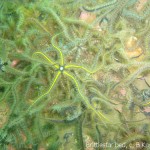 These including a fast run through the Creran Narrows, which Jo and I followed with a linked dive into an eddy pool by the North West shore, to get some better photos of the brittle star beds there, (it never ceases to amaze me how much colour there is in these beds, which appear from a distance to be rather unpleasant grey cob-webby places) before a rather hard swim back on the surface.
We also visited the wormery – where the serpulid reefs seem more substantial than ever – less substantial reefs are also to be found in the inner basin of Loch Creran.
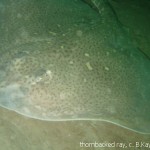 Our final dive though was at Galanach, where I wanted to visit the sea-pen beds, with the intention of getting some better photos. As a rather nice bonus, however, I saw a large thorn-backed ray, which hung about long enough for me to get his mug-shot!
We also managed a small amount of microscopy, looking at a single plankton sample from Galanach. Unfortunately the phytoplankton have now disappeared (they formed a substantial component of the samples at Lochaline last month), though there is a large amount of zoo-plankton, with copepods and barnacle larvae (cyprids) as the major component.
Posted: May 11th, 2011
Posted in dive trips
Usually we start the science section with stories from the vertebrates, and work ‘down’, in a blatant piece of species-ism. This time the anemones float to the top, however, with reports of how the corals might have evolved, and the id of one of the chemicals that induces their free-floating larvae to settle down. We end the section with a series of parties with the world’s largest vertebrates.
Fisheries and exploitation has a report about fishermen being paid to collect plastic. Sounds environmentally beneficial? We’re not sure how the collection will work, as while there is a vast amount of plastic waste at sea, is is usually in small fragments and not very concentrated, making for a very energy intensive clean-up. A skimming exercise that would remove small fragments will also remove many of the small invertebrates and plankton that form an essential part of the food chain… It will be interesting to see if there are any benefits from this bit of horse-trading.
Read the rest of this entry »
Posted: May 5th, 2011
Posted in Conservation, Marine science update, Science


