This issue we have tantalizing news of a new algal group – the rappemonads, which are reported to be common in both fresh and marine ecosystems, and goes to show the power of DNA based analysis. In conservation we have an article on seagrass in Northern Europe, which suggests that the eutrophication of coastal waters is an important factor. Seagrass (Zostra spp.) beds have largely disappeared from British waters, though I believe that disease has also been implicated here…
Finally, we end up in both hot and cold water in our section on climate change!
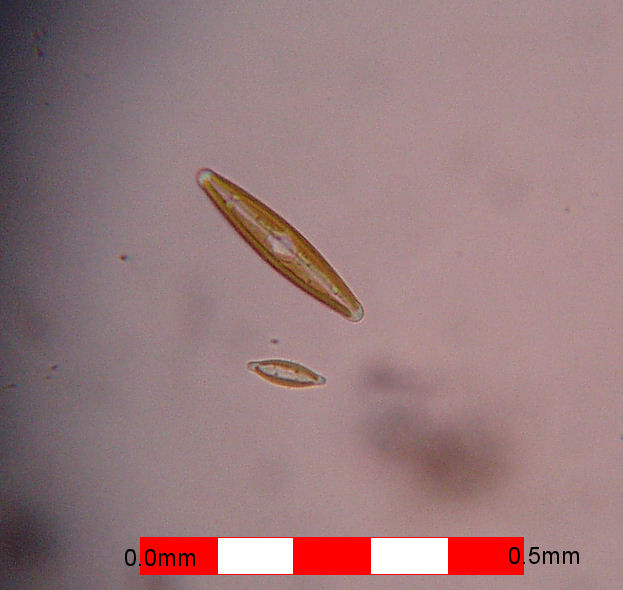
I’d been asked to look for diatoms in Morecambe Bay, – the project was to help people understand life in the Bay, and marine life in general, so it was an opportunity to look at the base of the marine food-chain. I was a little worried about actually finding anything at this time of year – January and February are usually very quiet for phytoplankton, before the spring bloom starts. As a consequence I suggested we looked for epiphytic diatoms, ones that live on surfaces, rather than floating in the water column. In this search we were lucky, with every one of our samples having some diatoms in. This is perhaps the nicest micrograph, with a couple of free-swimming pennate diatoms. No-one is actualy sure how these small plants move, but they are most certainly capable of a fairly respectable pace under the microscope!
We have three articles on how fish sense their surroundings in marine science this issue – from electrosensory arrays of sharks and rays, which help them oreintate themeselves in the water column and hunt for food, to a sense of smell that warns fish about predator activity on the reef. We end in climate change with a paper from PLoS 1 about how changes in carbon dioxide levels effect gene regulation in marine snails… Read the rest of this entry »
Very well done to everyone that turned up at Half Moon Bay, Heysham on Sunday 16th. Jan. to take part in the winter beach litter survey. The forecast for the weekend was very wet and windy, and sure enough the forecast was correct on Sunday morning, extremely wet. Wind and rain are not the ideal conditions for filling in recording sheets or managing flapping plastic collecting bags. The rain did ease a little whilst we were on the beach which was a help and the survey was completed successfully albeit with soggy recording sheets to decipher in the comfort of a motor car.
The Seasearch 'Guide to Seaweeds of Britain and Ireland'
Seasearch has recently released a guide to the seaweeds of Britain and Ireland. This excellent ID guide fills a space in the market. It has full colour photographs, size and location guides for over 200 seaweeds found around our coasts. Armed with this you will never need to attend a basic seaweed ID course again – so I’ll have to think of other ways of getting algae into our annual lecture series!
Best of all, there are copies available at a cut down price of (I think) £14.50 (c.f. the normal retail price of £16.95). Numbers are limited, please contact Mandy at one of our meetings to reserve yours!
We’ve got a number of papers on different aspects of biodiversity in this issue, amongst these there is an estimate of global seafloor biomass (about 100 megatons), how plankton may form specialised regional sub-species, and how diversity decreases under climatic stress (on this occasion the cooling of the poles). We’ll start, however, with a nice bit of kit that looks quite buildable for anyone wanting to take a look underwater without having to dive…