Lancashire MCS
Marine Conservation Society: Lancashire area group

Morecambe Bay seaweed sequence

Seaweed sequence at Jenny Browns Point, Morecambe Bay, UK

As part of the current Marine ID course I’ve been running around trying to get together photos of some common seaweed for part 2… Unfortunately the local coastline is not at all hospitable to seaweed, the extensive mudflats of Morecambe bay are good for molluscs and worms, but offer few attachment points for the larger algal species (I think the phytoplankton might be a fascinating study – but that would be a bit outside the current remit!).

Never the less, I took my camera down to the beach at the weekend for the MCS walk from Warton Crag and round Jenny Browns Point by Silverdale (Saturday 24th April).

Here there is some hard ground, allowing seaweed to get a hold. Highest up the rocks appeared Blidingia (filamentous green stuff) and small amounts of Ulva intestinalis (fatter tubular green stuff), followed by Pelvetia canaliculata (channel wrack), at the base of the sequence was Fucus spriralis (spiral wrack) – beyond that stretched the mud as far as the eye can see…

The complete sequence was over in about 30cm of height – so extremely truncated!

Thanks to Hilary for organising the walk (my feet have almost forgiven me!)

Posted: April 28th, 2010
Posted in Science, Uncategorized

Chlorophyl is not alone

The chlorophyl pigments have long been believed to be the basis for all autotrophy/phototrophy on earth, and these pigments therefore pretty much prop up the rest of the food chain (including yours truly). We know eukaryotic algae have a range of ‘helper pigments’ – this is why red algae are red, and not (usually!) green, but these transfer energy to the chlorophyl system, rather than drive metabolic pathways directly.

In 2000 a new group of membrane based proteins the proteorhodopsins were discovered in some cyanobacteria (blue green algae). These were shown to have the ability to drive a trans-membrane proton pump using only sunlight. Initially believed to have a sensory function, the latest work published in PLoS Biology indicates that the proton gradient created by the pump can drive the ADP-ATP conversion, and so be used as a general energy source for the cell. The long and the short of it is that cyanobacteria that have proteorhodopsin survive starvation in sunlight better than those that don’t, implying strongly that the proteorhodopsin generates real nutritional value for the bacterium.

This paper reinforces my prejudice that the prokaryotes are advanced organisms. These little guys might not have gone in for massive cellular machinery, but the chemistry they can do is really top notch!

Gómez-Consarnau L, Akram N, Lindell K, Pedersen A, Neutze R, et al. (2010) Proteorhodopsin Phototrophy Promotes Survival of Marine Bacteria during Starvation.
PLoS Biol 8(4): e1000358.doi:10.1371/journal.pbio.1000358

Posted: April 28th, 2010
Posted in Science

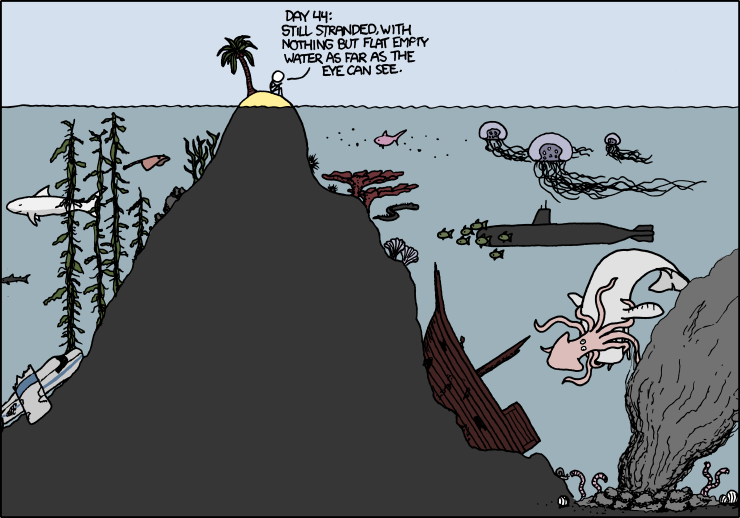
XKCD’s Desert Island

“Day 44: Still stranded with nothing but empty water as far as the eye can see”

XKCD's desert island

More truth in this cartoon than a page of words. Enjoy! (View full size).

Posted: April 28th, 2010
Posted in Uncategorized

Science roundup 22nd April 2010

Each week I scan several thousand blog and news posts, picking out ones of interest to me and writing a bit about them – if I have time. Two problems – selfish interest, and lack of time! Here I’m going to try something a bit different, and be a lot less selective, but only write a very short tag for each item. This way hopefully you get a chance to find stuff of interest w/o having to scan everything…

Here goes my marine science roundup #1:

Plankton’s importance for carbon fixation: In the marine ecosystem both eukaryotes and cyanobacteria are important for fixing carbon at the base of the food chain. This article indicates that the eukaryotes (diatoms, dinoflagellates, protozoa and ‘seaweed’) are responsible for a bit under half the total carbon fixation in the world’s oceans (via ScienceDaily, Apr. 16, 2010).

Seabed Biodiversity in Oxygen Minimum Zones: Lack of oxygen in the water column favours some unusual organisms, and can increase biodiversity (as long as the areas are not too large). From ScienceDaily Apr. 19, 2010.

Smart fish adapt to environmental changes: Living in a changing or dynamic environment seems to favour smarter fish. From PLoS Biology 8(4): e1000351. doi:10.1371/journal.pbio.1000351.

Masses more bugs: The number of microbial species in the world’s oceans may be one hundred times greater than previously estimated. From Nature News, April 18, 2010.

New species of bacterium discovered: I guess given the increase in the number of microbes now expected, reporting each discovery individually might have to go by the wayside – so make the most of it! This one was found in the gut of a worm that lives in a Swedish fjord…

Junk food: A beached whale that died in Puget Sound (US) was found to have a pair of trousers, a golf ball, surgical gloves, small towels, and more than 20 plastic bags in its stomach. The problem with plastic litter is not confined to the US, the MCS organises beach litter surveys around the UK to monitor the state of our seas, and bring pressure to bear to get them cleaned up. You can help – see our diary pages for the next beach cleanup!

Fish oil supplements provide no benefit: The largest ever trial of fish oil supplements has found no evidence that they offer benefits for cognitive function in older people. The trial author noted that the duration of the trial might not have been long enough for any true beneficial effects to be detected amongst this test group of initially healthy older people. From ScienceDaily Apr. 21, 2010.

Big Seas, Big Trouble? An extended article about the effects of increased CO2 on Ocean Acidification, and how that will effect life in the oceans in the coming decades. From Santa Barbara Independent Thursday, April 22, 2010

Carbon dioxide emissions causing ocean acidification: US congressional report finds that CO2 emissions will have unknown effects on marine life (see also previous article). From ScienceDaily Apr. 22, 2010.

What are you eating? DNA analysis shows that a large proportion of the fish eaten in Dublin is mis-sold as something it isn’t. Similar results have been reported in the US, and the problem is likely to be global. From ScienceDaily Apr. 22, 2010.

More than one killer whale? recent DNA profiling data suggests that there is more than one species of killer whale.

Posted: April 22nd, 2010
Posted in Marine science update, Science

Bacterial mat the size of Greece

We don’t usually try to ID bacteria, but this does not mean that they are unimportant. While each bacterium might be tiny, they can group together in enourmous numbers, and contribute a significant proportion of the biomass of any ecosystem. One recent discovery was a microbial mat lying on the sea floor off the coast of South America that covered an area the size of Greece!

The Census of Marine Life (previously blogged here) estimates that between 50 and 90% of the entire biomass of the marine system is in the form of microscopic organisms.

Our next Marine ID lecture on Wednesday 12 May the will look very briefly at some microscopic algae (phytoplankton), before turning to try and give pointers on how to identify some common (large and easily spotted) seaweeds!

More information:
Giant Undersea Microbial Mat (via Science Daily)
Census of Marine Life
MCS Diary – more lectures/meetings and events

Posted: April 19th, 2010
Posted in Science

Chagos marine reserve

Thanks to everyone for supporting this campaign, the Chagos islands have now been designated as a no-take marine reserve.

This declaration will make it the largest marine protected area in the world, totalling more than 210,000 square miles – an area twice the size of the UK. The combination of tropical islands, unspoiled coral reefs and adjacent oceanic abyss makes this area comparable in global importance to the Great Barrier Reef or Galapagos Islands.

More information about the Chagos islands project:

www.protectchagos.org

Posted: April 15th, 2010
Posted in Conservation