We’re just back from a very welcome long dive weekend near Oban, combined with an informal underwater photography course given by Lewis Bambury. On the 23rd we had two dives starting from the old Creagan Ferry slipway. This is situated on the North bank of Loch Creran, and about 100m after the new bridge, with a good sized layby to kit up in.
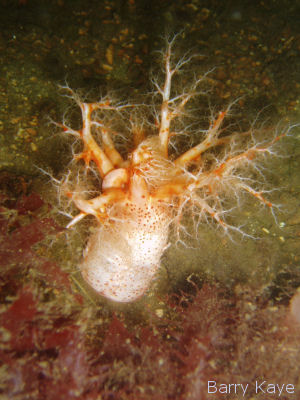
The weather was very wet, and the underwater visibility, at between 2 and 4m was unusually poor for the area – adding to the challenge of getting good photos (good photos were taken by others on the course, unfortunately you’ll have to make do with mine!). The morning dive was a low water bimble around the slipway itself, Loch Creran is home to numbers of sea cucumbers, of which the most commonly encountered is Psolus phantapus (see photo), which is bright orange, and these were the photographic high-spot of this dive, though there were also plenty of crabs, dead-mens fingers and squat-lobsters!
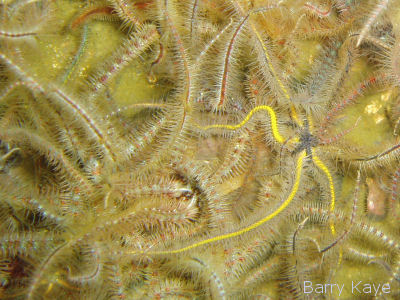
In the afternoon we drifted with the flood tide into the inner basin of Loch Creran – being at springs, there was with strong current. Or at least it was after we found it! – We’d taken a direct bearing to the bridge, and so ended up too close to the North side of the channel to get into the main current until we were pretty much under the bridge itself. Our route did take us through a deep basin immediately North West of the bridge, however (see charts). This contains an extensive brittle-star bed, which looks rather grey and unappealing at any distance, but go in close, and the grey hairyness resolves into myriads of brightly coloured brittle-stars (see photo). These are interspersed with the occasional giant starfish (typically 0.5m from arm-tip to arm-tip).
The final drift through under the bridge was very exhilarating, though with the stronger spring tide it was not possible to stop where we had intended, necessitating a 100m walk in full kit back to the car.
All in all, an excellent weekend, so thanks to Lewis and Gordon (who organised 5* accommodation and dive details).
Barry Kaye
Posted: May 27th, 2009
Posted in Uncategorized
Cod fisheries off the American coast have now largely collapsed, and recent research, by the University of Iceland and Marine Research Institute in Reykjavik, indicates that the remaining commercailly viable fisheries around Iceland are also teetering on the brink.
For a long time we have known that fishing exerts a strong pressure on the size and age at which cod mature. The scientists report that this has resulted in a reduction in the length at which a fish becomes mature by nearly one centimeter per year. The loss in size at maturity has a corresponding loss in fitness, with shallow water fish (the most heavily hunted) having only 8% of the fitness of their deep water counterparts. These changes are almost certainly hereditary, the fish responding to the dead-end that modern fisheries management has forced them into.
The authors speculate that the immediate establishment of large no-take reserves might relieve selection pressures on the fish, and avert a population collapse.
Full article Árnason et al. Intense Habitat-Specific Fisheries-Induced Selection at the Molecular Pan I Locus Predicts Imminent Collapse of a Major Cod Fishery. PLoS ONE, 2009; 4 (5):
This article via Science Daily Headlines
Posted: May 27th, 2009
Posted in Uncategorized
An expedition, led by Dr Anthony Grehan, has discovered extensive deep water corals, standing up to 2m high, off the Irish Coast. Possible sites for investigation were identified from the high resolution bathymetry collected by the Irish National Seabed Survey, and then identified by deep-sea Remote Operated Vehicle (ROV).
Via Science Daily Headlines
The depth that the corals were recorded at is not recorded in the article, or the main page on the NUI dsite. The Porcupine Bank, close to where the corals were dicovered, is between 80 and 100 fathoms* deep (140-180m), however, so we will not be arranging a dive trip(!). As an aside, the Porcupine bank is named after the Naval research vessel HMS Porcupine, from which the Porcupine Natural History Society also derives its name – small world…
Porcupine Marine Natural History Society
*From Haddock on the Porcupine Bank, September 1944 by C.F. Hickling MA
Posted: May 27th, 2009
Posted in Science
Basking sharks are welcome visitors to the British coastline during the summer months, when they swim close to the surface straining the sea water through modified gills to collect plankton. The species is listed as endangered and the MCS promotes and collects public sightings, through the Basking Shark Watch (BSW) project to try to help us understand more about this enigmatic animal.
Until recently, while summer sightings were quite common, nothing was known about the animals distribution during the winter months. Recently (May 14 2009), however, researchers have filled in the blanks. Satellite based tracking systems have followed basking sharks as they overwinter at depths between 200m and 1km, while migrating through the tropical waters of the Atlantic. The sharks were observed to stay at these depths for weeks or months at a time, effectively vanishing from sight!
For more information:
Science News Report
To report a sighting, or for more information on basking sharks in UK waters:
MCS basking sharks reportings
Posted: May 14th, 2009
Posted in Conservation, Science